|
|
|
|
|
|
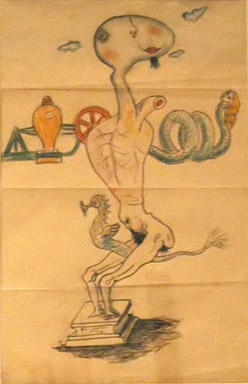
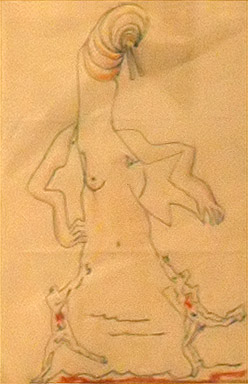
THE EXQUISITE CORPSE During the early years of the Surrealist movement, a typical evening spent among its poets and artists might include a game of "exquisite corpse." The exquisite corpse—the earliest among the many games invented by the Surrealists—was a kind of collective collage of words or images. Invented around 1925, either in the apartment of André Breton (1896-1966) on rue Fontaine or at 54 rue du Chateau, where the Surrealists Jacques Prévert (1900-1977), Yves Tanguy (1900-1955). and Marcel Duhamel (1900-1966) lived, the exquisite corpse was based on an old parlor game that used folded paper. The Abridged Dictionary of Surrealism (written by various Surrealists and published in 1939) defines the exquisite corpse:
In Andre Brétons The Exquisite Corpse: Its Exaltation (1975) the writer Tristan Tzara (1896-1963) described the rules of the game:
The exquisite corpse appeared for the first time in print in the journal La Revolution Surréaliste (October 1917). This publication reproduced five drawings and several poems without identifying their creators, which underscored the importance of the games collaborative intent. Bréton summarized this importance as follows:
The three exquisite corpse drawings from the Bergman collection on display here are extremely rare, and they illustrate the principle of poetic brainstorming so important to Surrealist methodology. |
|
|
|
| Top illustration: Exquisite Corpse, March 18, 1927 André Masson (French, 1896-1987) Max Ernst (American and French, born Germany, 1891-1976) Max Morise (French, 1900-1973) Graphite and colored crayons on ivory wove paper 200 x 155 mm Lindy and Edwin Bergman Collection, 104.1991 ©2008 Artists Rights Society (ARS), New York / ADAGP, Paris Text and images from: |
|
|